
Visual Audio Splitter & Joiner
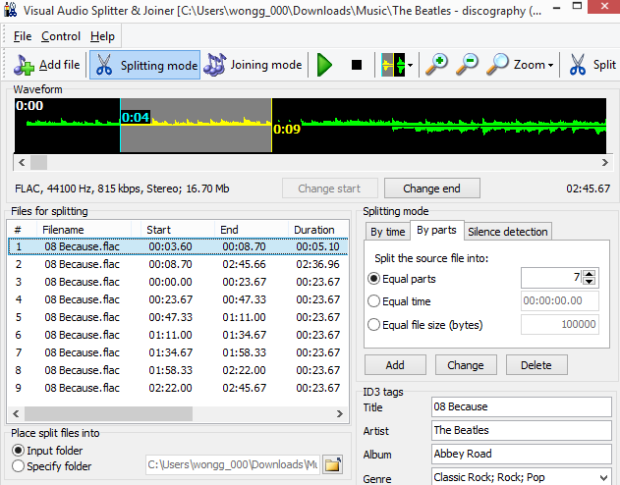
A handy software utility that can split and combine audio files. Cut files fast and easy using the waveform without losses in quality.


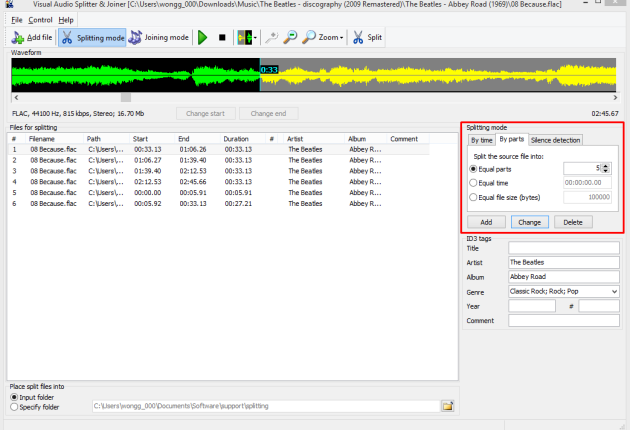
Split MP3, WMA, APE, and WAV files by a number of equal parts, by size, by duration. All the supported formats are split directly, without conversion!



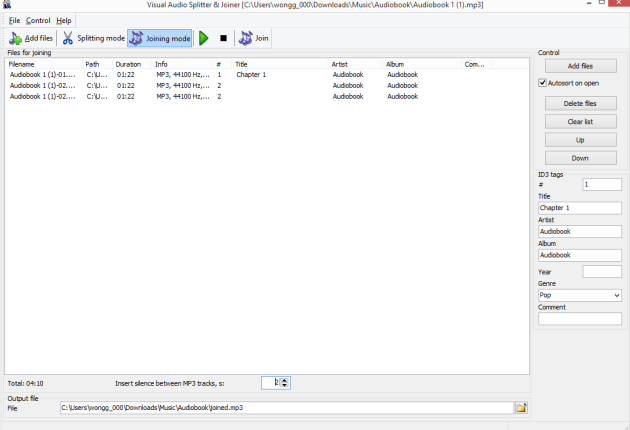
Visual Audio Splitter & Joiner allows you not only to split multiple audio files at once but also in any order. Join MP3, APE, WMA, and WAV files in any succession. Note that only parts in the same format can be merged. So if you want to merge files in different formats, you can convert them to the desired output format with AudioConverter Studio.

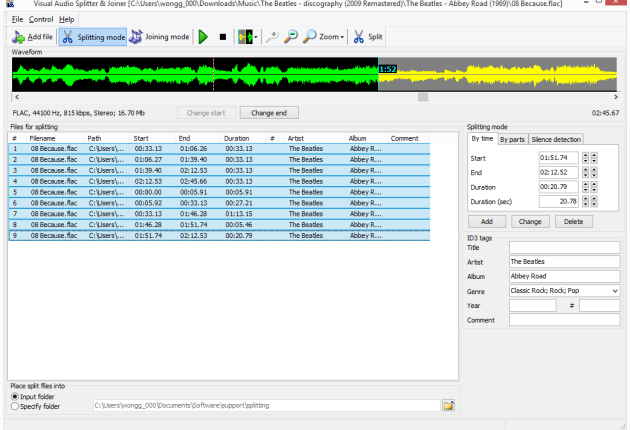
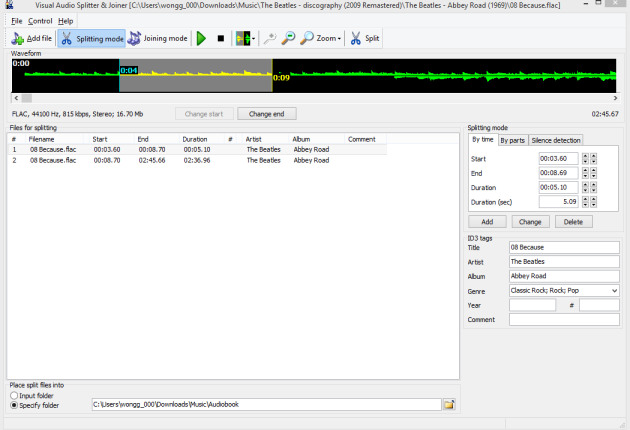
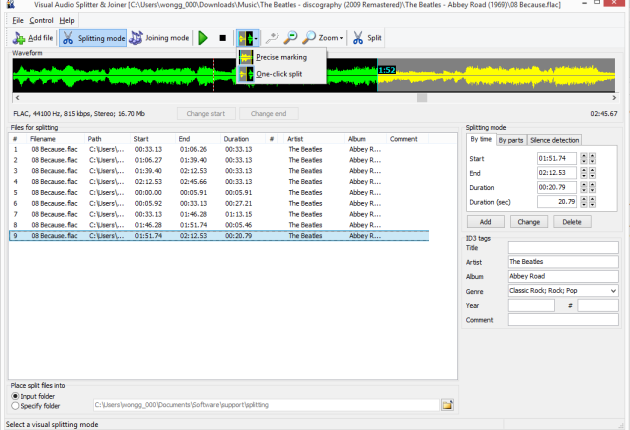
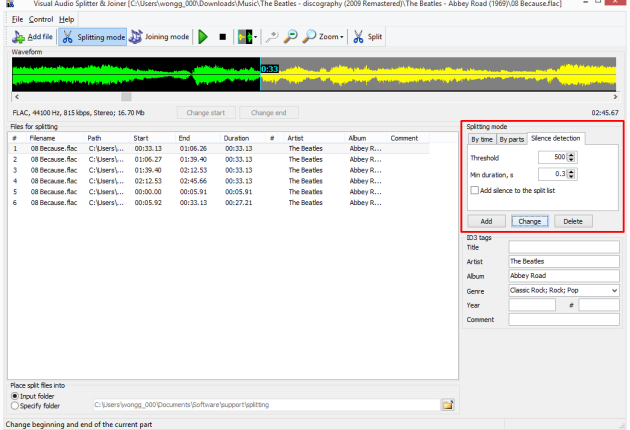
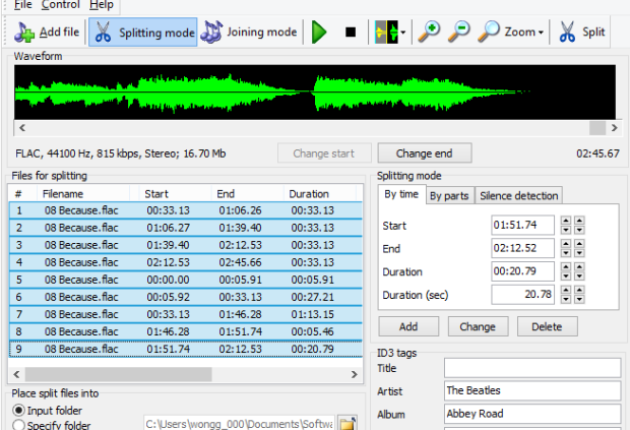
Suppose that you have an album of your favorite band in a single file and want to get easy access to each song. Visual Audio Splitter & Joiner is the right tool for this. In just a few seconds it will detect pauses between songs using the silence detection feature. All you need to do is to click the “Split” button. The MP3 splitter will deliver the result in virtually no time.

CUE files can be also used with media players. Nowadays many media players support CUE sheets either by using plugins or by initial design. CUE sheet is a simple text file (in ASCII encoding) which contains information concerning how audio tracks should be laid out on a CD.
Visual Audio Splitter & Joiner will help you create CUE sheets that will retain the detailed information. In this case, you don’t actually split the file but merely save the information about its parts into a CUE file.


Visual Audio Splitter & Joiner is so fast that you might ask: “Is it good for my files?”. The funny thing is, however, that Visual Audio Splitter & Joiner has absolutely no impact on quality.
As display technology evolves, Chip-on-Film (COF) and Tape Automated Bonding (TAB) failures have become a primary cause of LCD/LED panel degradation. This paper examines the role of curated data collections, specifically those aggregated by platforms like Kazmi Elecom, in facilitating "Flying Line" bypass repairs. We analyze the technical necessity of COF datasheets and the efficiency gained through structured data repositories.
The transition from Tape Carrier Packages (TCP) to Chip-on-Film (COF) in 1998 allowed for narrower display bezels and higher resolution. However, COF modules are prone to data line failures. Repairing these modules often requires bypassing damaged internal traces using external "Flying Wires". This process is impossible without accurate pinout data and voltage specifications (VGH, VGL). Download TAB COF Data Collection Kazmi Elecom part14 rar
To address your request, you can find the on the Kazmi Elecom website, which is a known repository for LCD/LED TV repair software and datasheet collections. These collections typically include "Flying Line" figures and IC datasheets essential for panel bypass repairs. As display technology evolves, Chip-on-Film (COF) and Tape